Changing drivers of intact forest loss highlight the urgency of global forest Conservation
The world's remaining Intact Forest Landscapes (IFLs)—large, continuous areas of natural forest that remain free from significant human disturbance—are disappearing at an alarming rate. New analysis by the World Resources Institute (WRI) shows that while forests continue to face pressure from agriculture, logging, mining and infrastructure development, the principal driver of forest landscape reduction has shifted dramatically over the past two decades.
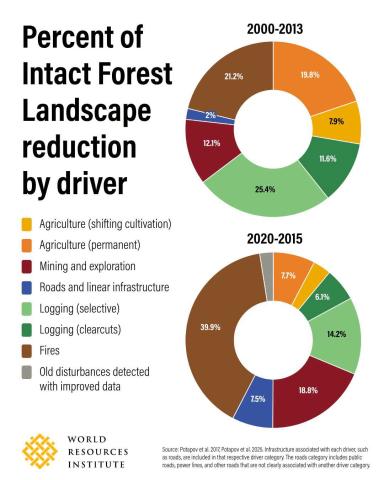
Between 2000 and 2013, timber harvesting was the dominant cause of intact forest landscape reduction worldwide. Selective logging accounted for approximately 25.4% of forest loss, while clear-cut logging contributed 11.6%, making commercial timber extraction the largest overall pressure on intact forests. Permanent agriculture (19.8%), fires (21.2%) and mining (12.1%) were also significant drivers during this period.
However, the picture has changed markedly in recent years.
According to updated WRI analysis covering 2020 to 2025, wildfires have become the leading driver of intact forest landscape reduction, accounting for 39.9% of total forest loss. This represents a substantial increase compared to the previous period and reflects the growing impacts of climate change, prolonged droughts and extreme weather events on forest ecosystems.
Mining and mineral exploration have also increased as a driver of forest loss, rising from 12.1% to 18.8%, while roads and other linear infrastructure expanded from 2% to 7.5%, illustrating the continued pressure from infrastructure development and extractive industries.
In contrast, losses associated with permanent agriculture and commercial logging have declined proportionally, although they remain significant threats. Selective logging decreased from 25.4% to 14.2%, while clear-cut logging declined from 11.6% to 6.1%. Permanent agricultural expansion fell from 19.8% to 7.7%, and shifting cultivation now represents a much smaller proportion of intact forest reduction.
These findings demonstrate that forest conservation can no longer focus solely on controlling deforestation. Increasingly, countries must integrate climate adaptation, wildfire prevention, sustainable land-use planning and ecosystem restoration into national biodiversity strategies.
Healthy intact forests provide irreplaceable ecosystem services. They conserve biodiversity, regulate water cycles, store vast amounts of carbon, stabilize local and regional climates and support the livelihoods and cultural values of Indigenous Peoples and local communities. Once fragmented, these ecosystems become more vulnerable to fires, invasive species and further degradation.
For Kenya, the changing global trends reinforce the importance of protecting remaining natural forests while restoring degraded landscapes under national initiatives such as the 15 Billion Tree Growing Programme, implementation of the National Landscape and Ecosystem Restoration Strategy, and the country's commitments under the Kunming-Montreal Global Biodiversity Framework (KMGBF).
Protecting intact forest landscapes contributes directly to several KMGBF targets, including:
- Target 2 – Restore degraded ecosystems.
- Target 3 – Conserve and effectively manage areas important for biodiversity.
- Target 8 – Minimize the impacts of climate change on biodiversity.
- Target 10 – Promote sustainable management of forests and production landscapes.
- Target 11 – Maintain and enhance ecosystem functions and services.
- Target 14 – Integrate biodiversity values into policies, planning and development.
- Target 15 – Encourage businesses to reduce biodiversity-related risks and impacts.
The evolving drivers of forest loss send a clear message: safeguarding the world's remaining intact forests requires integrated action that addresses both human-induced pressures and the increasing impacts of climate change. Investing in forest conservation, sustainable land management, fire prevention and ecosystem restoration is essential to securing biodiversity, climate resilience and sustainable livelihoods for future generations.