Kenya Hosts National Workshop to Strengthen Biodiversity Monitoring under the Kunming-Montreal Global Biodiversity Framework
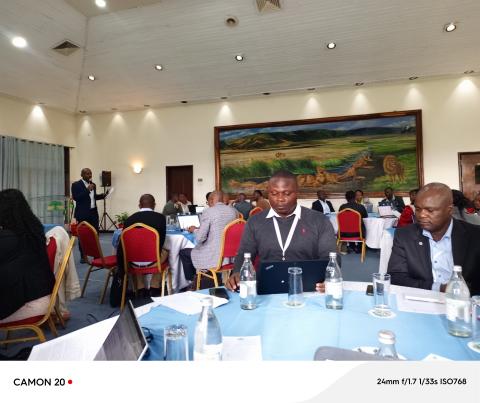
Nairobi, Kenya – 28 May 2026 — The State Department for Environment and Climate Change, in collaboration with key national and international partners, convened the Kenya National Data Mapping and Validation Workshop on Kunming-Montreal Global Biodiversity Framework (KM-GBF) Headline Indicator 22.1 and Target 2 at Safari Park Hotel, Nairobi.
The two-day workshop brings together representatives from government institutions, Indigenous Peoples and local community organizations, research institutions, technical agencies, civil society organizations, and development partners to strengthen Kenya’s biodiversity monitoring, reporting and ecosystem restoration efforts under the Convention on Biological Diversity (CBD).
The workshop is jointly supported by the Food and Agriculture Organization of the United Nations (FAO), the International Land Coalition (ILC), the World Resources Institute (WRI), CIFOR-ICRAF, the Regional Centre for Mapping of Resources for Development (RCMRD), and IMPACT-Kenya.
The meeting focuses on Headline Indicator 22.1, which addresses land-use change and land tenure in the traditional territories of Indigenous Peoples and local communities (IP & LCs), and its relationship with Target 2 of the GBF, which calls for the effective restoration of degraded terrestrial, inland water, coastal and marine ecosystems.
Speaking during the opening session, participants emphasized the importance of inclusive, evidence-based and rights-responsive biodiversity governance, particularly in a country such as Kenya where community lands, ecosystem restoration initiatives and customary tenure systems play a significant role in biodiversity conservation and sustainable development.
The workshop provides a national platform for reviewing Kenya’s Seventh National Report submitted under the CBD, particularly the datasets, methodologies, assumptions and institutional processes used in reporting on HI22.1 and Target 2. Discussions are also focusing on identifying technical and institutional gaps, improving coordination among data holders, and strengthening future biodiversity monitoring and reporting systems.
Participants are undertaking technical mapping and validation of datasets related to:
- Community land and customary tenure systems;
- Land-use and land-cover change;
- Ecosystem restoration and rehabilitation;
- Biodiversity monitoring and geospatial information;
- Community-based monitoring and information systems (CBMIS);
- Traditional knowledge and local stewardship systems.
The workshop further seeks to strengthen collaboration between official government data systems and community-generated information while promoting principles of data governance, consent, safeguards and contextual accuracy.
Kenya has already taken significant steps in implementing the GBF monitoring framework, including contributing to the refinement of the global methodology for Headline Indicator 22.1 and submitting information relevant to the indicator in its Seventh National Report to the CBD. The country also continues to implement major ecosystem restoration initiatives under the National Biodiversity Strategy and Action Plan (NBSAP), national landscape restoration programmes and community land governance frameworks.
Expected outputs from the workshop include:
- A reviewed inventory of Kenya-relevant datasets and institutions related to HI22.1 and Target 2;
- A technical validation summary on available methodologies and data systems;
- A national gap and action matrix identifying priority technical and institutional needs;
- A workshop report and technical-policy brief to support future CBD reporting and learning exchanges.
The workshop is expected to contribute to stronger institutional coordination, improved understanding of biodiversity and community land datasets, and enhanced national capacity for future reporting under the Kunming-Montreal Global Biodiversity Framework.
The outcomes of the meeting will also support wider regional and global biodiversity discussions, including ongoing CBD processes leading to SBSTTA-28 and COP17.