Kenya to Host Marine and Coastal Biodiversity Conservation Workshop for Kenya and Tanzania
Mombasa, Kenya | 26–30 January 2026
Kenya will host a Marine and Coastal Biodiversity Conservation Workshop for Kenya and Tanzania from 26 to 30 January 2026 in Mombasa, bringing together policymakers, technical experts, researchers, and practitioners to strengthen regional collaboration on marine and coastal biodiversity conservation.
The five-day workshop is organized under the auspices of the Nairobi Convention Secretariat (NCS) in collaboration with UNEP, national CBD and Nairobi Convention focal points from Kenya and Tanzania, and regional partners. The workshop aims to support the implementation and updating of National Biodiversity Strategies and Action Plans (NBSAPs) in line with the Kunming–Montreal Global Biodiversity Framework (GBF), with a specific focus on marine and coastal ecosystems.
Focus on NBSAPs, Data, and Regional Integration
The workshop will provide a platform for Kenya and Tanzania to:
- Review the status of NBSAP implementation and national reporting, including preparation of the 7th National Reports to the CBD;
- Identify data gaps and indicators relevant to marine and coastal biodiversity and GBF targets;
- Share best practices in biodiversity assessment, mapping, and valuation, including blue carbon ecosystems;
- Strengthen regional and transboundary cooperation for marine and coastal conservation in the Western Indian Ocean region.
Key sessions will highlight UNEP support to NBSAP updates, marine biodiversity indicators under the UNEP Regional Seas Programme, and lessons from national and sub-national experiences in Kenya, Tanzania, and Zanzibar.
Advancing OECMs and the 30 by 30 Target
A major component of the workshop will focus on Other Effective Area-based Conservation Measures (OECMs) and their contribution to achieving the “30 by 30” biodiversity target, particularly in marine and coastal areas.
Participants will engage in:
- Discussions on guidelines for identifying, recognizing, and reporting OECMs;
- Spatial mapping of OECMs in Kenya and Tanzania;
- Policy and legal frameworks supporting OECMs in both countries;
- Practical country exercises on identification, delineation, and assessment of potential OECMs.
These sessions will support countries in improving national reporting and strengthening recognition of community-led and co-managed conservation areas.
Field Learning and Community Engagement
The workshop will conclude with a field visit to Gazi, a globally recognized site for mangrove conservation, community-based management, and blue carbon initiatives. The field visit will allow participants to connect policy discussions with on-the-ground conservation practice, community livelihoods, and ecosystem restoration efforts.
Expected Outcomes
Key expected outcomes of the workshop include:
- Enhanced technical capacity for marine and coastal biodiversity assessment and reporting;
- Improved alignment of Kenya’s and Tanzania’s NBSAPs with GBF targets;
- Strengthened regional data integration and collaboration under the Nairobi Convention;
- Clear next steps for updating Kenya’s NBSAP and national reporting, and addressing gaps in Tanzania’s NBSAP.
Strengthening Regional Cooperation
By bringing together Kenya and Tanzania, the workshop reinforces the role of the Nairobi Convention as a platform for regional cooperation in conserving marine and coastal biodiversity in the Western Indian Ocean. The outcomes will contribute directly to national priorities, regional commitments, and global biodiversity goals.
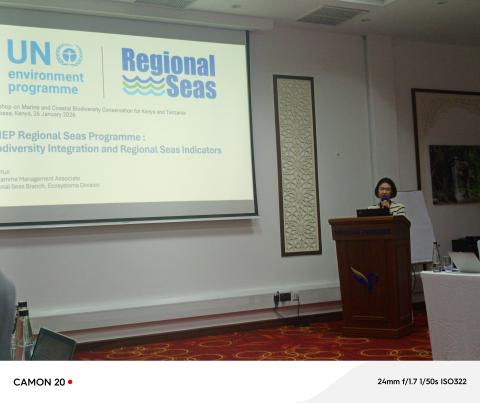
UNEP’s Regional Seas Programme Marine and Coastal Biodiversity Indicators Presentation
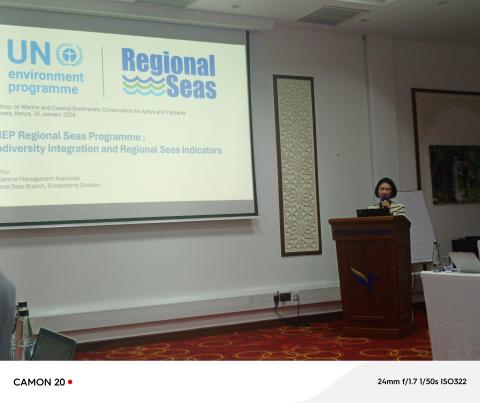
Presenter: UNEP/Regional Seas Branch (UNEP/RSB), Sora Yun
UNEP’s Regional Seas Programme develops marine and coastal biodiversity indicators to help countries better monitor, assess, and report on the health and condition of their marine ecosystems. These indicators are designed to support implementation of global commitments such as the Kunming–Montreal Global Biodiversity Framework (GBF), the 2030 Agenda for Sustainable Development (especially SDG 14), and regional conservation strategies.
Source:
Nairobi Convention Secretariat (NCS), in collaboration with UNEP and national CBD and Nairobi Convention Focal Points – Kenya and Tanzania.