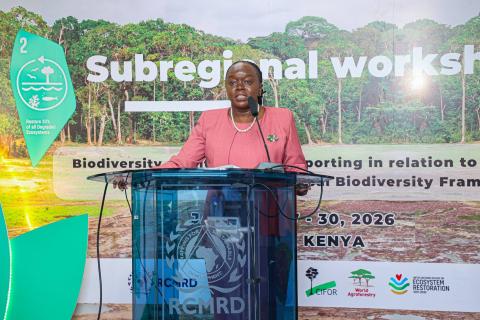
Cabinet Secretary Dr. Deborah Mlongo Barasa officially launched the Regional Centre for Mapping of Resources for Development (RCMRD) as a Sub-Regional Technical and Scientific Cooperation Support Centre
Cabinet Secretary Dr. Deborah Mlongo Barasa earlier today officially launched the Regional Centre for Mapping of Resources for Development (RCMRD) as a Sub-Regional Technical and Scientific Cooperation Support Centre under the Convention on Biological Diversity (CBD).
The CS was received by Dr. Emmanuel Nkurunziza, Director General ( RCMRD), and Mr. Patrick Mucheleka, Chairperson of the RCMRD Governing Council and Permanent Secretary, Ministry of Lands and Natural Resources, Zambia.
Dr. Barasa also presided over the opening of the Subregional Workshop on Biodiversity Monitoring and Reporting in relation to Target 2 of the Kunming–Montreal Global Biodiversity Framework.
The launch marks a major milestone in strengthening Africa’s regional capacity for biodiversity monitoring, ecosystem restoration, and science-based reporting. The designation of RCMRD positions the Centre as a strategic hub for technical cooperation, geospatial analysis, earth-observation data, and harmonised methodologies to support countries in meeting their obligations under the Global Biodiversity Framework.
Speaking during the event, Dr. Barasa underscored the critical role of credible data, measurable indicators, and transparent reporting in translating global biodiversity commitments into tangible action on the ground. She emphasised that Target 2 on ecosystem restoration is central to protecting livelihoods, enhancing climate resilience, and safeguarding natural capital across the region.
The Subregional Workshop brings together government representatives, technical experts, development partners, and regional institutions to strengthen capacity on biodiversity monitoring systems, restoration baselines, and reporting processes ahead of COP 17 of the Convention on Biological Diversity.
Kenya reaffirmed its commitment to regional cooperation, South–South learning, and science-driven implementation, noting that the strengthened role of RCMRD will enhance Africa’s collective readiness, coherence, and leadership in halting and reversing biodiversity loss while advancing sustainable development priorities.